 Euro
Euro
 British Pound
 US Dollar

What Is a Buffy Coat? Isolation, PBMCs & DNA Extraction
Buffy coats
What Is a Buffy Coat?
A buffy coat is the thin, pale layer of blood cells that forms between the plasma and packed red blood cells after anticoagulated whole blood is centrifuged. It is enriched in white blood cells and platelets and is widely used in immunology, molecular biology, genetics, biobanking and other biomedical research.
The term “buffy coat” might make you think of a shiny car wax, but in the world of blood banking, buffy coat refers to the white layer between red blood cells and plasma in a unit of whole blood after it has been spun down in a centrifuge. The buffy coat contains white blood cells, the soldiers of the immune system.
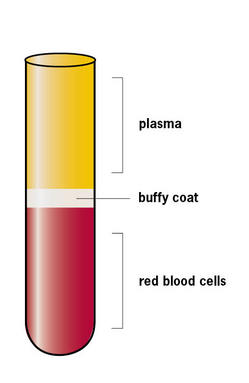
Scientifically, the buffy coat contains not only white blood cells, or leukocytes, but also a substantial proportion of the platelets present in the sample. Small amounts of residual red blood cells may also be present depending on the centrifugation and collection method.
What Does Buffy Coat Mean in Blood?
When anticoagulated whole blood is centrifuged, components separate mainly according to their physical properties, including density.
The resulting tube typically contains three visible regions:
| Blood fraction | Position after centrifugation | Main components |
|---|---|---|
| Plasma | Top | Water, proteins, electrolytes and soluble molecules |
| Buffy coat | Middle | Leukocytes and platelets |
| Red blood cells | Bottom | Erythrocytes |

The buffy coat is normally a very thin layer and represents less than approximately 1% of the total blood volume in a conventional centrifuged sample.
This simple physical separation makes the buffy coat particularly valuable because it concentrates nucleated blood cells into a much smaller volume than the original whole-blood sample.
What Is in the Buffy Coat?
The buffy coat contains a mixture of leukocytes and platelets.
Its leukocyte population can include:
- Lymphocytes, including T cells, B cells and natural killer cells
- Monocytes
- Neutrophils
- Eosinophils
- Basophils
- Platelets
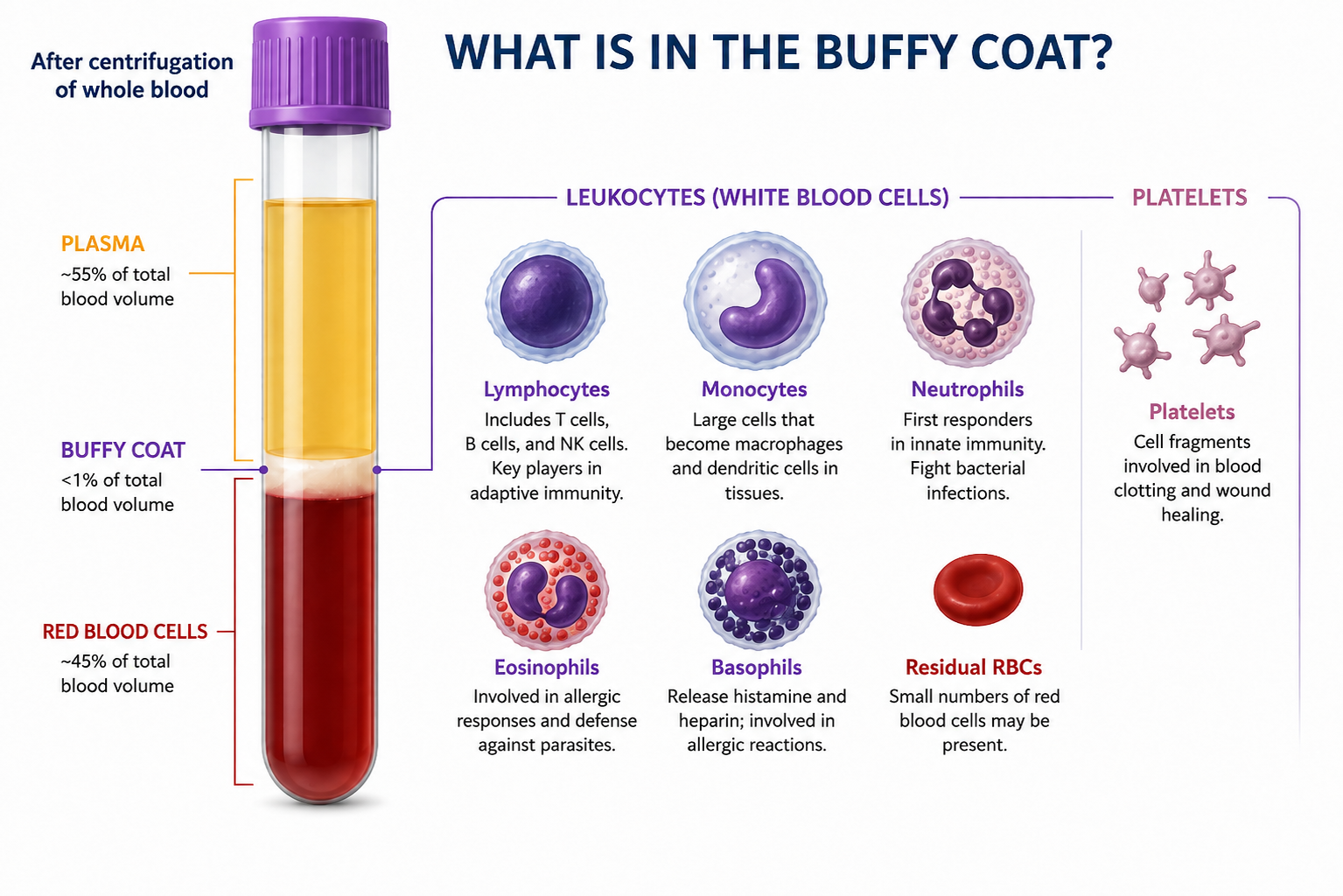
Studies of centrifuged blood show that leukocyte populations are distributed across different regions of the buffy coat according to their physical characteristics.
This is an important distinction because the term buffy coat does not refer to a purified population of lymphocytes or PBMCs.
Quick scientific definition :
Buffy coat = leukocyte- and platelet-enriched fraction of centrifuged anticoagulated whole blood.
How Does a Buffy Coat Form?
A buffy coat forms during centrifugation of anticoagulated whole blood.
Because blood components differ in density, centrifugal force causes them to redistribute.
1. Red blood cells move toward the bottom
Erythrocytes represent the densest major cellular fraction and form the packed red blood cell layer.
2. Plasma remains at the top
Plasma forms the upper liquid fraction.
3. Leukocytes and platelets concentrate at the interface
Between the plasma and erythrocytes, a pale interface develops.
This is the buffy coat layer.
International biobanking guidance describes it as a thin greyish-white layer containing white blood cells and platelets above the packed erythrocytes.
What Is Buffy Coat Isolation?
Buffy coat isolation is the process of separating the leukocyte- and platelet-rich intermediate layer from centrifuged whole blood.
In a typical laboratory workflow:
Whole blood → Centrifugation → Plasma → Buffy coat → Red blood cells
After centrifugation, the buffy coat can be carefully collected from the interface between plasma and red cells.
Depending on the research objective, the recovered material may subsequently be used directly, frozen for biobanking, processed for nucleic acid extraction, or further separated to obtain specific cell populations.
Exact centrifugation forces, anticoagulants, temperatures and downstream processing conditions should therefore be selected according to the validated protocol for the intended application rather than treated as universally interchangeable.
Buffy Coat vs PBMC: What Is the Difference?
One of the most important scientific distinctions is between buffy coat and PBMCs.
They are related, but they are not the same material.
| Feature | Buffy Coat | PBMCs |
|---|---|---|
| Full meaning | Leukocyte/platelet-rich blood fraction | Peripheral blood mononuclear cells |
| Lymphocytes | Yes | Yes |
| Monocytes | Yes | Yes |
| Neutrophils/granulocytes | Usually present | Mostly excluded |
| Platelets | Commonly present | May remain as contamination |
| Typical preparation | Centrifugation of whole blood | Usually density-gradient separation |
| Main applications | DNA/RNA extraction, cell source, biobanking | Immunology, cell culture, functional assays |
What are PBMCs?
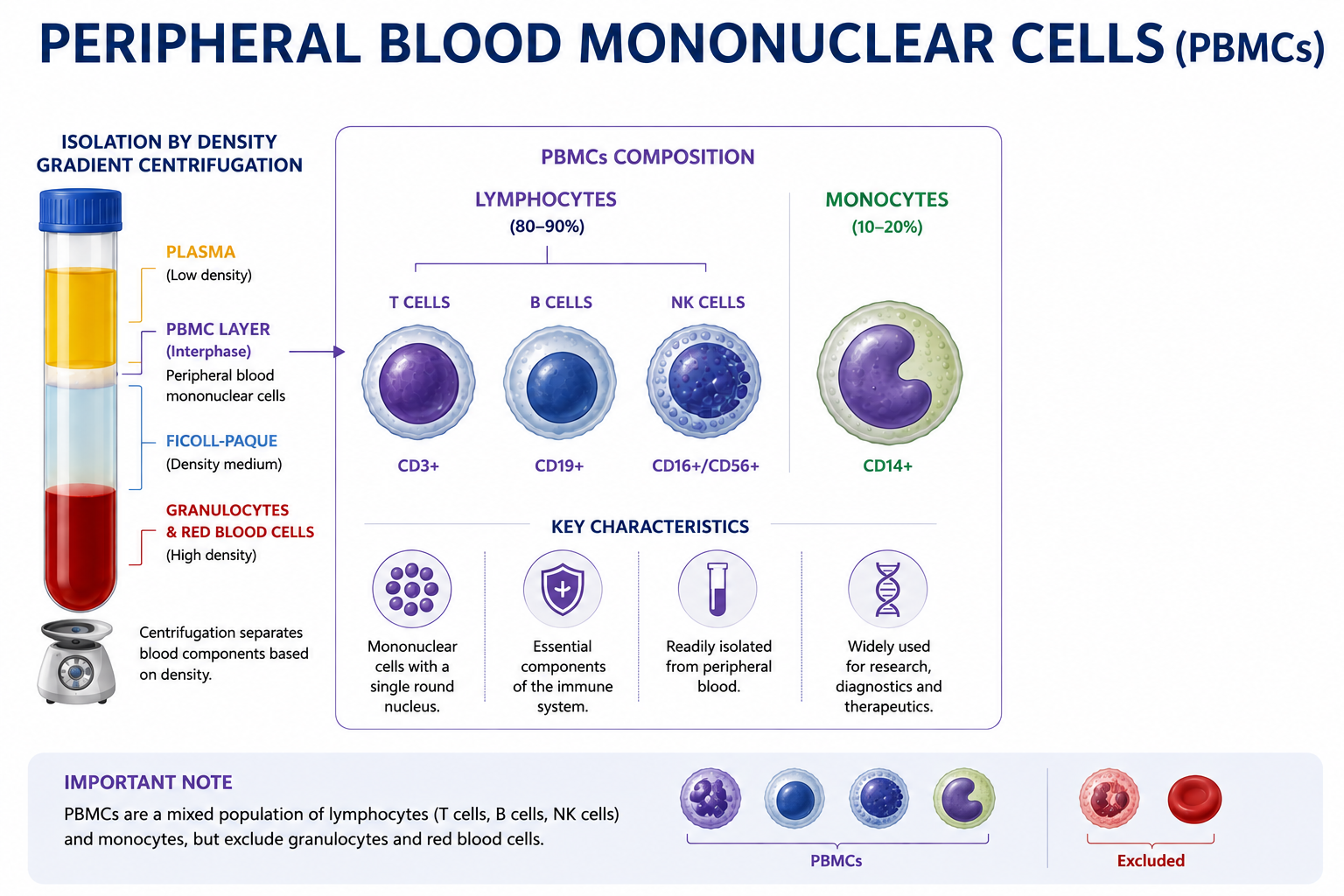
Peripheral blood mononuclear cells, or PBMCs, are primarily lymphocytes and monocytes.
When blood is processed using a density-gradient medium such as Ficoll, PBMCs can be separated from denser granulocytes and erythrocytes. Published PBMC isolation procedures therefore describe recovery of a mononuclear-cell interface following density-gradient centrifugation.
Can PBMCs be isolated from buffy coat?
Yes.
Buffy coats are frequently used as starting material for PBMC isolation because they provide a concentrated source of leukocytes. Further density-gradient separation can enrich the mononuclear fraction containing lymphocytes and monocytes.
Therefore:
Buffy coat → starting leukocyte-rich material
PBMCs → more specifically isolated mononuclear leukocyte population
Why Are Buffy Coats Important in Scientific Research?
Buffy coat samples combine a high concentration of nucleated blood cells with relatively convenient collection, processing and storage.
They are therefore valuable in several research areas.
1. Genomics
Most mature human red blood cells do not contain nuclei, whereas leukocytes contain genomic DNA.
Concentrating leukocytes in the buffy coat consequently provides an effective source of human genomic DNA.
Applications include :
- PCR
- qPCR
- Genotyping
- SNP analysis
- Genome-wide association studies
- DNA sequencing
- Molecular epidemiology
- Pharmacogenomics
Long-term studies have demonstrated that DNA isolated from appropriately stored buffy-coat samples can remain suitable for genome-wide genetic analysis after years of frozen storage.
DNA Extraction From Buffy Coat
DNA extraction from buffy coat is one of the most common applications of this blood fraction.
The main advantage is straightforward: the buffy coat concentrates nucleated leukocytes, while most erythrocytes and plasma have already been removed.
The general workflow is:
Buffy coat
↓
Cell lysis
↓
Release of genomic DNA
↓
Protein and contaminant removal
↓
DNA purification
↓
DNA quantification and quality control
↓
PCR, sequencing or genotyping
Buffy coat has therefore been widely used as a biological source for nucleic-acid extraction in biobanks and molecular studies.
Why use buffy coat instead of whole blood for DNA extraction?
Potential advantages include:
Higher concentration of nucleated cells
Most of the red-cell fraction has already been removed.
Reduced sample volume
A leukocyte-rich fraction can occupy considerably less storage space than the original whole-blood specimen.
Biobanking efficiency
Aliquoted buffy coats can be stored for future molecular studies.
Compatibility with many molecular workflows
Purified DNA can subsequently be used for PCR, genotyping and sequencing.
However, DNA yield depends on factors such as starting blood volume, leukocyte count, processing procedure, storage conditions and extraction chemistry.
Buffy Coat in Biobanking
Buffy coats are particularly valuable for biobanks and longitudinal research studies.
One blood collection can potentially provide several research fractions :
Whole blood
→ Plasma
→ Buffy coat
→ Red blood cell fraction
The buffy coat can then serve as a concentrated source of cells or nucleic acids for future experiments.
Biobanking literature specifically identifies buffy coat as an important source of DNA and RNA, although optimal preservation conditions depend strongly on the analyte being studied.
This makes buffy-coat banking useful for large-scale studies involving:
- Human genetics
- Epidemiology
- Biomarker discovery
- Molecular diagnostics research
- Population studies
- Precision medicine research
Buffy Coat and Immunology
Because the buffy coat concentrates leukocytes, it is also valuable in immune-cell research.
Researchers can use buffy-coat-derived material to isolate or investigate:
- T lymphocytes
- B lymphocytes
- Natural killer cells
- Monocytes
- Granulocytes
- Other leukocyte subsets
Depending on the experiment, additional purification methods may be required.
For example, density-gradient centrifugation can enrich PBMCs, while magnetic or flow-cytometric cell separation can subsequently isolate selected immune-cell populations.
Thus, buffy coat often acts as a starting biological material rather than the final purified cell population.
Buffy Coat vs Whole Blood
Researchers often need to decide whether to work with whole blood or buffy coat.
| Application | Whole Blood | Buffy Coat |
|---|---|---|
| Complete hematological sample | Excellent | No |
| Genomic DNA extraction | Yes | Excellent |
| Leukocyte enrichment | Limited | Excellent |
| PBMC isolation | Yes | Excellent starting material |
| Plasma biomarker studies | Yes | No |
| Long-term leukocyte banking | Possible | Common |
| RNA research | Possible | Possible with appropriate preservation |
The correct choice therefore depends on the scientific objective.
What Is a Buffy Coat in PRP?
The PRP buffy coat refers to the relationship between the buffy-coat fraction and platelet-rich plasma preparation.
PRP stands for platelet-rich plasma.
During certain PRP preparation methods, the position from which material is collected relative to the buffy coat influences the leukocyte content of the resulting preparation.
Leukocyte-rich PRP :
If the collected fraction incorporates more of the buffy-coat region, the preparation can contain higher numbers of leukocytes and may be classified as leukocyte-rich PRP (L-PRP).
Leukocyte-poor PRP :
Protocols designed to minimize buffy-coat collection can produce preparations with lower leukocyte concentrations.
Reviews of PRP preparation describe this distinction and emphasize that different centrifugation and collection methods can produce substantially different cellular compositions.
Therefore, PRP and buffy coat should not be considered synonymous.
What Does a Large Buffy Coat Mean?
A visibly larger or thicker buffy-coat layer generally indicates that the centrifuged interface contains a greater volume of cellular material.
Because the buffy coat contains leukocytes and platelets, its thickness can be influenced by their abundance as well as by the centrifugation and sample-processing conditions.
Historically, quantitative buffy-coat techniques have even been used to estimate hematological parameters such as white-cell and platelet counts.
However:
The appearance or thickness of a buffy coat alone is not sufficient to diagnose a medical condition.
A complete blood count and validated laboratory measurements are required to determine actual leukocyte and platelet concentrations.
Buffy Coat Applications at a Glance
| Research field | Buffy coat application |
|---|---|
| Genetics | Genomic DNA extraction |
| Genomics | Genotyping and sequencing |
| Molecular biology | PCR and qPCR |
| Immunology | Leukocyte and PBMC source |
| Cell biology | Isolation of immune-cell populations |
| Biobanking | Long-term storage of cellular material |
| Epidemiology | Population genetic studies |
| Biomarker research | Cellular and molecular analysis |
| Transcriptomics | RNA-based studies when properly preserved |
| Blood research | Leukocyte and platelet investigations |
Buffy Coat, PBMC and Plasma: Quick Comparison
A useful way to remember the difference is :
Plasma
→ cell-poor liquid fraction
Buffy coat
→ leukocytes + platelets
PBMCs
→ mainly lymphocytes + monocytes
Red blood cell fraction
→ predominantly erythrocytes
This distinction is especially important when selecting biological material for genomics, immunology or cell-culture experiments.
Frequently Asked Questions About Buffy Coat
What is the buffy coat?
=> The buffy coat is the thin leukocyte- and platelet-rich layer found between plasma and packed red blood cells after centrifugation of anticoagulated whole blood.
What is the buffy coat in blood?
=> It is the pale intermediate cellular layer created when whole blood is separated by centrifugation.
What is in the buffy coat?
=> The buffy coat contains white blood cells and platelets, including lymphocytes, monocytes, granulocytes and other leukocyte populations.
Why is it called a buffy coat?
=> The name refers to the pale or buff-colored appearance of the thin layer formed between plasma and red blood cells.
Does buffy coat contain red blood cells?
=> The fraction is designed to concentrate leukocytes and platelets, but small numbers of erythrocytes can remain, particularly around the interface between the buffy coat and packed red-cell fraction.
Is buffy coat the same as PBMC?
=> No. A buffy coat contains a broader mixture of leukocytes and platelets. PBMCs are predominantly lymphocytes and monocytes isolated from peripheral blood.
Can PBMCs be isolated from buffy coat?
=> Yes. Buffy coat is commonly used as starting material for PBMC isolation using density-gradient separation or other cell-separation methods.
Can DNA be extracted from buffy coat?
=> Yes. Buffy coat is an important source of genomic DNA because it concentrates nucleated leukocytes.
Why use buffy coat for DNA extraction?
=> It provides a concentrated source of nucleated cells while reducing much of the plasma and erythrocyte content of whole blood.
What does a large buffy coat mean?
=> A thicker layer can reflect a greater amount of leukocyte/platelet-rich cellular material, but its visual size alone is not a diagnostic measurement.
Is buffy coat used for PRP?
=> The buffy-coat region can influence the leukocyte content of some PRP preparations. Incorporating more buffy-coat material generally produces a more leukocyte-rich preparation.
Why Buffy Coat Is Valuable for Modern Biomedical Research?
The buffy coat may represent only a small fraction of centrifuged blood, but it contains biologically valuable cellular material.
Its concentration of leukocytes and platelets makes buffy coat particularly useful as a starting material for :
DNA extraction → Genomics → PBMC isolation → Immunology → Cell research → Biobanking
As molecular and cellular research increasingly relies on well-characterized biological specimens, proper separation, preservation and documentation of buffy-coat samples can substantially influence experimental reproducibility and downstream data quality.
For researchers asking “what is a buffy coat?”, the simplest answer is therefore also the most important :
The buffy coat is the leukocyte- and platelet-rich layer of centrifuged blood that provides researchers with a concentrated source of blood cells for molecular, genetic and cellular studies.